
Castillo de la Triste Condesa
Castillo de la Triste Condesa
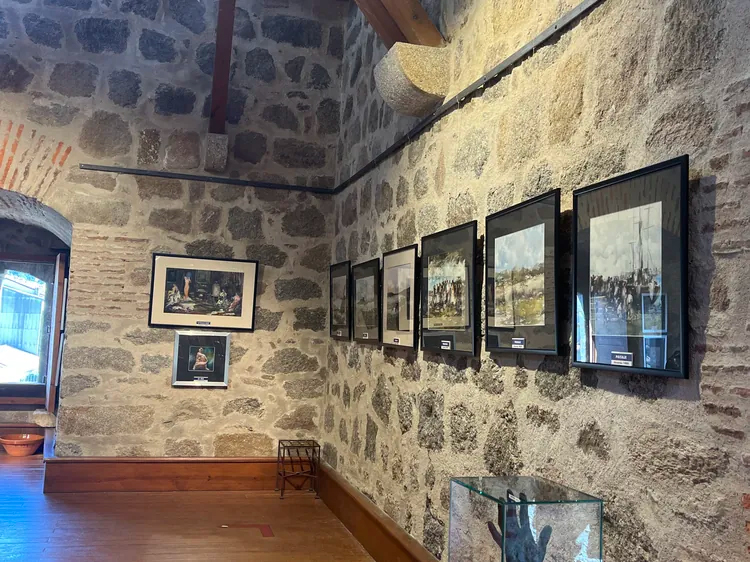
On this third floor is the permanent museum of Manuel Aznar, a local painter born in Arenas de San Pedro in 1927.
Between 1951 and 1959 he studied acting at the Institute of Cinematographic Research and Experiments. During that time he appeared in the movie "La estrella de Sierra Morena," with Lola Flores, and in another film, "Así es Madrid." He also worked as a journalist.
Throughout this period he exhibited his works in various galleries in Ávila, Arenas de San Pedro, and Alicante. Later he emigrated to Germany, where he collaborated with the weekly magazine "Siete Fechas" from 1967 to 1974. He made a book on bullfighting in German with his own illustrations, and in 1976 he received the gold medal at the III European Biennial of Art in Emigration.
On January 9, 2009, he inaugurated his exhibition in this homage tower. He passed away on August 9, 2010, at the age of 83.
EXHIBITION.
His legacy is divided into two spaces.
The journey begins with two female allegories, in shades of green and dark: Dawn and Dusk.
On the left side of the staircase leading up, your gaze rises to a Christ on the Cross placed above the stairs. The stairs themselves invite you to use them as a prayer bench.
On the opposite side, to the right, are "Las Fantasías de Arenas," with three emblematic monuments: the castle, the church, and the bridge. Black and white drawings and surrealistic perspectives emerge. They are joined by four green and black paintings depicting women and their mysteries.
The second space is spacious and open. It starts with still life, based on the reconstruction of fruits and flowers that convey a sense of life. Different textures, tonal channels, and firm brushstrokes build up for the viewer the chromatic sense the artist uses.
The second group, to the right, brings together landscapes united by dramatic skies. In the three windows, images related to Soviet aesthetics celebrate the sensual and erotic image of women.
On the front wall, two outstanding works stand out, and beneath them, two nudes represent Day and Night.
On the left wall, in the first section, women take center stage. The sight of five women leads the eye across them.
In the last section, from anthropological perspectives, the connection between women and water forms one of the final chapters of the journey. A painted sculpture dominates the central axis of this route towards the staircase.
On the wall panels, the works narrate the importance of sketches in the sculptor-painter's process.
And finally, the descent down the staircase leads to Saint Jerome in penance: a journey to the hermit's cave, Aznar's sacred cave.