
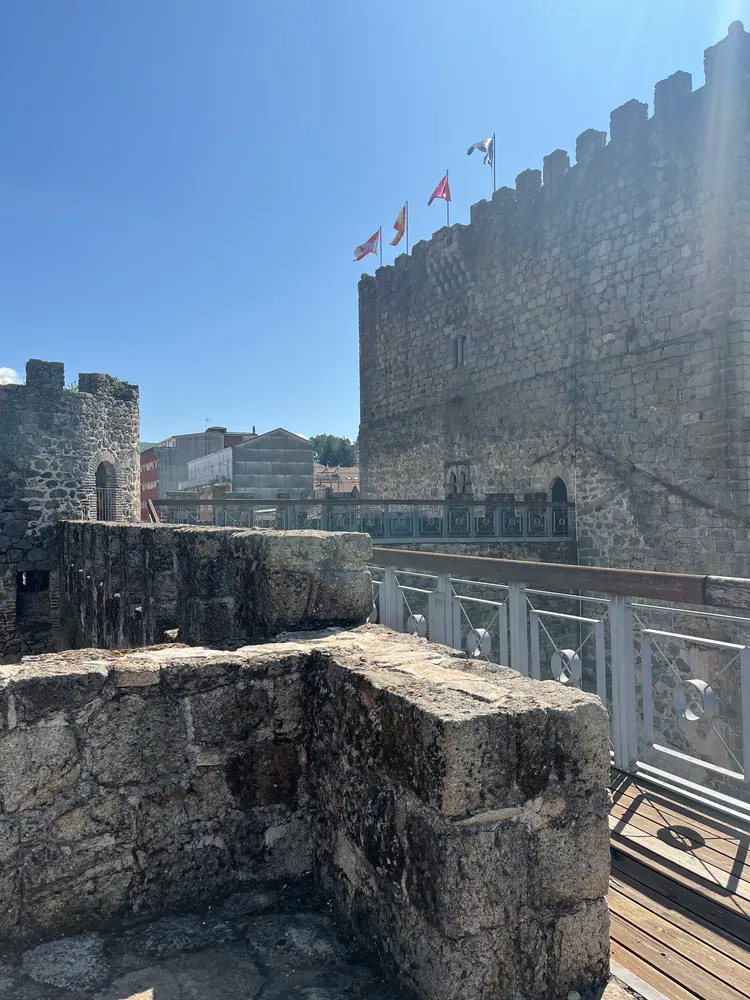
Castillo de la Triste Condesa
Castillo de la Triste Condesa
Before you return to the homage tower, there are two of the oldest neighborhoods in Arenas still to see.
Ancient Muslim Quarter:
The Mozarabic communities gained some importance in this land of Arenas. The Arab or Muslim quarter lay in what are now the neighborhoods of La Nava and El Canchal. Its people worked as builders, potters, craftsmen, muleteers and tanners, and that is why they settled by the river: to make use of its waters.
Of the presence of those Arabs and Moors, few traces are left in Arenas. The Mudéjar-style windows on the second floor of the castle's Homage Tower. Some structures of old houses. And the names of certain streets: Calle de la Media Luna, Calle de Solomando, and Calle y Travesía de los Hornos, which remind us of the old Moorish kilns.
La Nava is one of the oldest neighborhoods in Arenas. "Nava" means flat land without trees, a depression, and the name describes its location perfectly: on the outskirts of the town, along the river. It is a picturesque neighborhood, known for its fountain, and it has inspired many artists and folk songs.
El Canchal, as its name suggests, is a slope covered with large rocks or stones. It preserves its exceptional traditional architecture: houses of stone and lime, wooden balconies and beams. It is one of the most portrayed and photographed neighborhoods in Arenas, and possibly where part of the old Moorish suburb stood.
Ancient Jewish Quarter:
In the town of Arenas there was a Jewish community with the status of aljama. That means it had everything needed to lead a fully Jewish life: synagogue, rabbi, cemetery, butcher shop, Talmudic school, and more.
The charter of villazgo, granted in 1393, drew new settlers, and among them the Jewish community. But it did not reach the status of aljama until 1474.
The community worked in trade, tax collection, usurious money lending, and activities related to the Mesta, the powerful association of sheep farmers. It also practiced humble trades: shopkeepers, blacksmiths, fishermen. And it was responsible for collecting the montazgo, a type of tax, in Ramacastañas. It is even known that Abraham Senior, chief rabbi of the aljamas of Castile, came to that town in person to recover it.
The Jewish quarter was in the northernmost part of the town, in a well-placed neighborhood. One of its streets bears a telling name, "Calle de la Sinagoga," which shows where the Hebrew temple stood.