
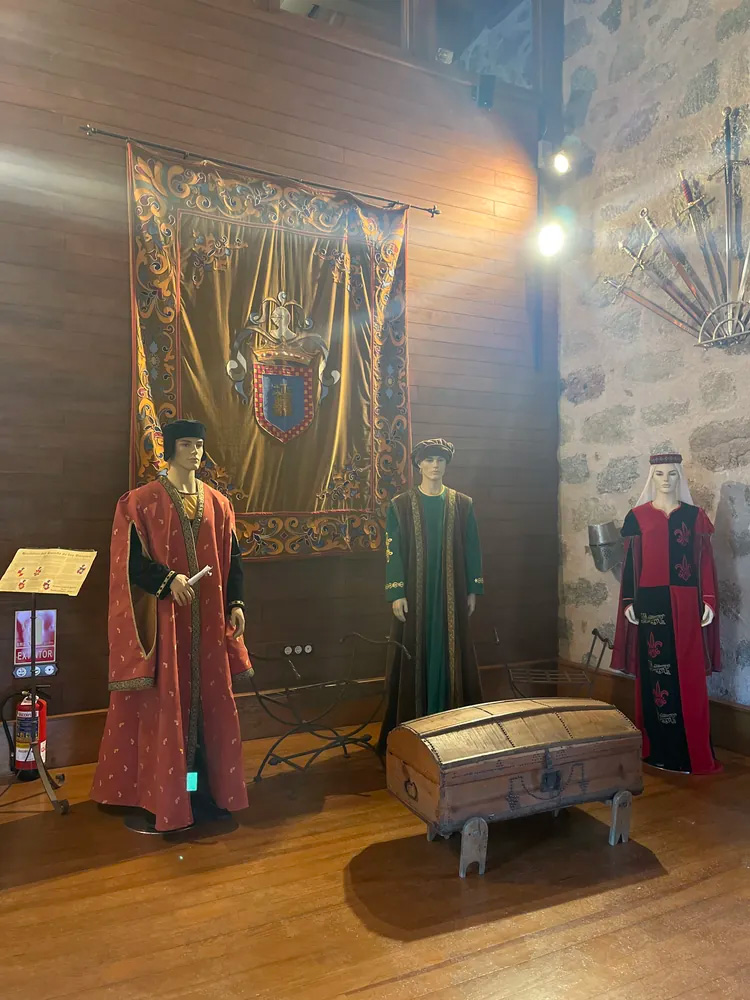
Castillo de la Triste Condesa
Castillo de la Triste Condesa
She became a widow and, instead of withdrawing, signed her documents "The Sad Countess." Doña Juana de Pimentel was born in 1404 in Castile, into two of the most powerful Castilian lineages: the Pimentel and the Enríquez. Her father was Rodrigo Alonso Pimentel, 2nd Count of Benavente; her mother, Leonor Enríquez, daughter of the lords of Medina de Rioseco. Her father gave her the lordship of Arenas de San Pedro as a dowry when she married Don Álvaro de Luna, Condestable of Castile, Grand Master of the Order of Santiago, and favorite of King Juan II of Castile. They had two children: Juan de Luna Pimentel, 2nd Count of San Esteban de Gormaz, and María de Luna Pimentel, who married Iñigo Hurtado de Mendoza, 2nd Duke of the Infantado. In 1453 the Condestable is executed. Doña Juana is left a widow, and she devotes her efforts to reclaiming her children's patrimony and restoring the memory and legacy of her husband. She shows no restraint or submission: she is resilient, rebellious, and courageous. She takes her troops against the Castilian monarch, Enrique IV, and his favorite, Juan Pacheco, Marquis of Villena, whom she accuses of her husband's death. It is a conflict that lasts her whole life, with her daughter María de Luna and her granddaughter Juana de Luna often at its center. María de Luna was one of the wealthiest women of her time and, for that reason, one of the most sought after for politically advantageous marriages among the Castilian nobility. Two of the most powerful families ask for her hand: the Pachecos and the Mendozas. After a series of events worthy of any medieval movie, the Mendozas win. That alliance, through her marriage to the heir of the House of Infantado, helps María defend her lordships and her lineage's interests. Doña Juana dies in Guadalajara, after a full and eventful life. She is buried in the Cathedral of Toledo, alongside her husband Don Álvaro.